The Best Divisions
or Knowledge of the Regions,
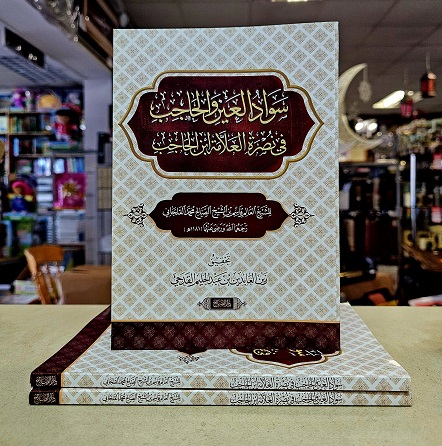
[A5+] Large Paperback - 454 pages,
( Ahsan al-Taqasum fi Ma’rifat al-Aqalim )
by Al-Muqaddasi - (Maqdisi]) [d.389h]
Transl. by Prof Basil Collins,
by Mohammad Alta'i
*Published by Garnet Books.
About this book :
One thousand years ago al-Muqaddasi, “the man from Jerusalem”, wrote in Arabic an epic geographical treatise, which is also a great work of literature. This treatise was based on some twenty years of experiences undergone and observations noted in his survey of the realm of Islam, from the Atlantic to the Indian Ocean.
Early in the second half of the nineteenth century the German orientalist, Aloys Sprenger, brought to the attention of the West a manuscript of al-Muqaddasi’s [Maqdisi] work. Sprenger’s enthusiasm over the content of the manuscript is reflected in his judgement that its author is the greatest geographer of all time; and this view is shared by many scholars. The translation by Basil Anthony Collins published here is the first rendition into a Western language of al-Muqaddasi’s treatise.
Al-Muqaddasi was born in the year 945 of the Common Era (CE), which corresponds to the year 334 of the Islamic calendar (AH), and he died towards the close of the millennium. Defining the area of his study as that where the presence of the religious and political institutions of Islam dominated, he travelled throughout the regions observing, enquiring, researching, corroborating, weighing and sifting evidence, taking notes and writing drafts. Ahsan al-Taqasim fi Ma’rifat al-Aqalim, The Best Divisions for Knowledge of the Regions, was eventually published in 985CE/375AH, and a revised edition was produced three years later.
Al-Muqaddasi attributes his motivation for travelling for twenty years, suffering hardships and writing about his travels, to divine inspiration: the accomplishment would be pleasing to his Lord, and would give life to his own memory. At the same time, the suggestion that he journeyed as an agent for the Fatimid regime in Egypt cannot be dismissed. Whatever the reason for his travels, al-Muqaddasi shows himself to be a hardy, intelligent, versatile, resourceful and well-informed man. He designed his book to appeal to a variety of interests, and even to entertain. Yet, quite strikingly, his perspective on aspects of the geographical method touches on concerns which have received greater attention only in more recent times. For example, his ranking of settlements according to their functions is quite prescient, his use of maps in accord with modern practice and his excursion into determinism based on toponymy is, to say the least, unusual.
Shaykh al-Muqaddasi [Maqdisi] Shams al-Din Abu ‘Abd Allah Muhammad ibn Ahmad (945 - 1000 CE) Rahmatullahi ta'ala 'alayhi, was a distinguished Palestinian Arab geographer from Jerusalem, renowned for his seminal book, Ahsan al-Taqasim fi Ma'rifat al-Aqalim, which documented the 10th-century Islamic world through his travels and observations. Born in Jerusalem, he had a substantial education and devoted nearly twenty years to the study of geography following his initial Hajj.
Al-Maquddisi is one of the first examples of a traveler who became fully engaged in his environment, literally working his way from country to country. At various times he was employed as a teacher, scribe, courier, doctor, lawyer, papermaker, bookbinder, and even a muezzin.
His major opus, finalised in 985 CE, partitioned the Islamic world into 14 sections and underscored the interconnection of social, cultural, and economic dimensions with physical geography. Al-Muqaddasi innovated a holistic methodology in human geography, employing direct observation and local interviews, and is acknowledged as one of the earliest individuals to self-identify as Palestinian. His work constitutes a significant contribution to medieval Islamic geography, providing insights into the many communities and landscapes of the era.
More Islamic History.
Dimensions : 24 x 17cm.
*Off-mint. Minor creasing and marks on covers.